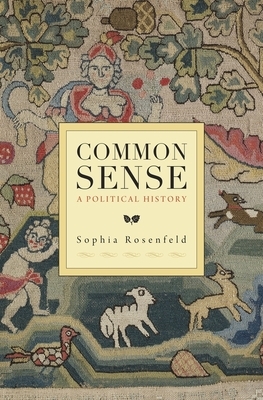
Sophia Rosenfeld’s analysis of the historical uses and meaning of “common sense” demonstrates that the concept is complex and often used to avoid analytic thought.
This is a big book written for the general reader by an experienced tech journalist. It is a slow read for someone who know only the hype about AI. She explains the development of OpenAI in language that convey basic ideas about how large language models were invented and developed.
The AI Con: How to Fight Big Tech’s Hype and Create the Future We Want,by Emily M. Bender & Alex Hannah, 274 pages, ISBN/UID: 9780063418561, May 2025, Harper
This book is shorter and less demanding than Hao’s book. It is not as thorough on some of the topics that Hao covers, but it is more lively and more wide ranging
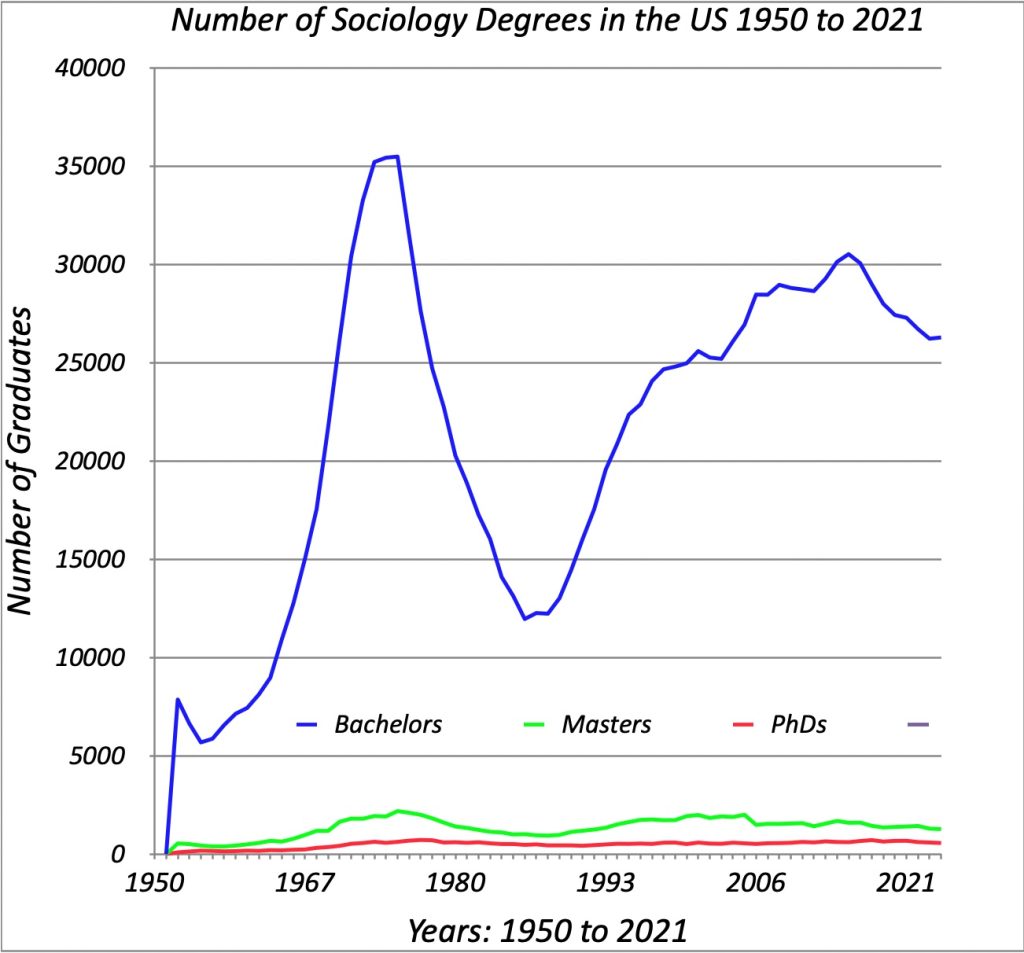
The maximum year for Bachelor’s degrees was 1973-74 (35,491) and the minimum was 1984-85 (11,968).
The maximum year for Master’s degrees was 1973-74 (2,196) and the minimum was 1957-58 (397). Later, 1987-88 was low (984).
The maximum year for Doctor’s degrees was 1973-74 (2,196) and the minimum was 1949-50 (98). Later, 1989-90 was low (432).
In 2020-2021the number of Sociology Bachelor’s Degrees was 26,291, Master’s Degrees 1,283 and Doctor’s Degrees 573. This downward turn after three decades of growth could reflect different size age cohorts and relative interest in Sociology. Remember that these are raw numbers and not rates. The large peak in the early 1970s is probably a baby-boom effect and the rise around the turn of the century a second wave effect from the baby-boom.
What other factors might affect the number of sociology graduates?
SOURCE: U.S. Department of Education, National Center for Education Statistics, Earned Degrees Conferred, 1949-50 through 1969-70; Higher Education General Information Survey (HEGIS), “Degrees and Other Formal Awards Conferred” surveys, 1970-71 through 1985-86; Integrated Postsecondary Education Data System (IPEDS), “Completions Survey” (IPEDS-C:87-99); and IPEDS Fall 2000 through Fall 2021, Completions component. (This table was prepared October 2022.) You can find the source here.
Nymphalis antiopa, known as the mourning cloak in North America and the Camberwell beauty in Britain, is a large butterfly native to Eurasia and North America. The immature form of this species is sometimes known as the spiny elm caterpillar. Wikipedia
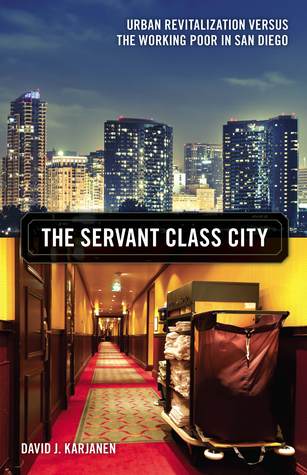
Karjanen, David J. The servant class city: urban revitalization versus the working poor in San Diego. Minnesota, 2016. 292p ISBN 9780816694624, $98.00; ISBN 9780816697489 pbk, $28.00; ISBN 9781452953366 ebook.
Karjanen (American studies, Minnesota) examines the servant class (hospitality industry, retail, informal work). Good jobs (regular and sufficient hours with benefits and ladders for advancement) are very scarce. With a limited social safety net, people rely on “do-it-yourself” safety nets of family and friends. Asset poverty makes the risks associated with unexpected costs or expenditures on education and training too high for the reward. Karjanen argues that conventional policy prescriptions fail in the complex situations these workers face. Job quality is more important than the number of jobs. The working poor need financial institutions designed to help them build assets. Karjanen is skeptical that current policies work. Urban policy should be more like public health practice and preventive medicine. This valuable case study does an excellent job of demonstrating the complex reality the hardworking poor face in neoliberal capitalism. Largely a descriptive study, the book is slow reading except for the vignettes in later chapters and the author’s discussion of what is wrong with current policy. For collections in the sociology of work, urban studies, and inequality. Summing Up: Recommended. Upper-division undergraduates and above.
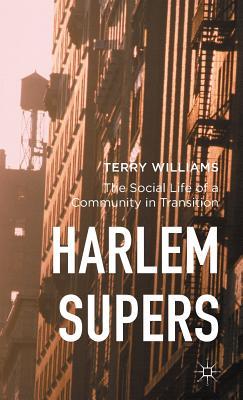
Williams, Terry. Harlem supers: the social life of a community in transition. Palgrave Macmillan, 2015 (c2016). 243p ISBN 9781349562411 pbk, $34.99
Terry Williams, author of The Cocaine Kids, Crackhouse, and The Conmen,
continues his work on urban life in this book on Harlem “supers”,
(managers responsible for repair and maintenance in a residential
building). The text is full of field notes from nine supers selected for
different locations and personal characteristics. It is part memoir,
Williams has been a super and an investor in buildings that employ
supers. His story and the stories of the supers he interviews are
intertwined. The book is very digressive and the narrative thread is
easily lost. He asserts that supers are crucial actors in their
communities, but he does not give the reader a clear idea about how this
works. It compares to Doormen by Peter Bearman, but does not
develop sociological theory as well. Williams mentions many sociological
concepts, but does not adequately link these ideas to the supers.
Advanced students can make the links, but younger students will not.
There are few photos, no captions, and no map for reference to building
and neighborhood locations. The book is suitable for advanced urban
courses but not for work or occupations.
Readership Levels Upper-division Undergraduates, Graduate Students, Researchers/Faculty, Professionals/Practitioners
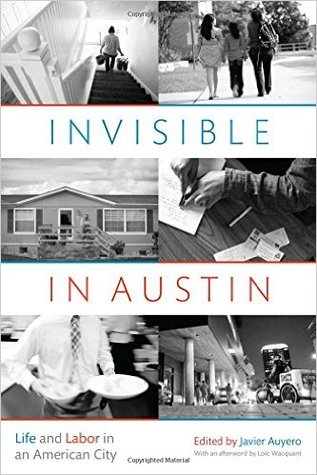
Invisible in Austin: life and labor in an American city, ed. by
Javier Auyero. Texas, 2015. 271p bibl afp ISBN 9781477303658 pbk,
$24.95.
Inspired by the work of Pierre Bourdieu, 12 students and a professor
in a sociology graduate seminar produced this collection of life stories
from what sociologist Loïc Wacquant called the “urban precariate.”
Each student met with a respondent in multiple conversations over
several months. The students “fashioned” stories from these
conversations and through collective discussion in the seminar. All
respondents were shown drafts of the stories before publication. Some
stories contain mild caveats about the accuracy of the facts or opinions
related. One chapter outlines the historical context of Austin, Texas
and the other 11 include a construction worker, a waitress, a sex
worker, a copier repairman, a musician, a house cleaner, a taxi driver,
and others. The writing is clear and interesting, reminiscent of
journalism and memoir. Sociological concepts are introduced in each
chapter without much elaboration. The stories explore the tension
between structural constraints (neoliberal Texas state policy,
gentrification, segregation) and the individuals’ struggles to make
meaning of their lives and their situations. Wacquant’s Afterword
provides a theoretical discussion and suggestions for further work. For
students in the social sciences, especially work, inequality, and urban
policy. SUMMING UP: Highly recommended. All levels/libraries.